 |
The exact dates of Islam's
spread in Indo-China is not known for certain. However, generally
speaking, Islam arrived in Indo-China before it reached China during the
Tang Dynasty (618-907). It was introduced by merchants from the Muslim
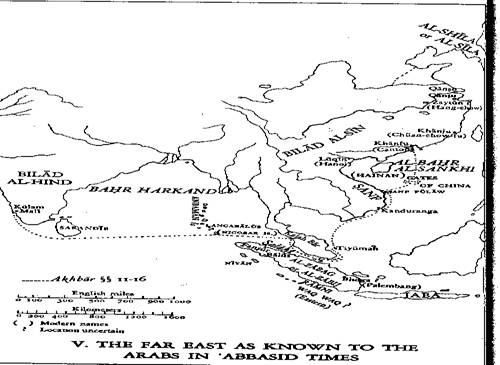
world who sailed along the coastal cities. The following is a map and a
quote from "Arab Seafaring" by George F. Hourani:
"After the passage through the
Malacca Strait, known to the Arabs by its Malay name of Salaht
("Strait"), a call was made at Tiuman Island. Next cutting across to
Indo-China, they stopped at ports in Sanf, the Champa kingdom in the
eastern coastal, then at an island off the coast, known as Sanf Fulaw
(corrupted in our texts to "Sandar Fulat"). From there vessels might
coast round the Gulf of Tongking to Hanoi, known as Luqin, before they
made for their final destination, Canton, which was called Khanfu."
|
|
When Islam came, few Champa
people adopted it. However, some time between 1607 and 1676, the king of
Champa became Muslim thus precipitating most of his people to enter
Islam also.
Throughout the century, the
Champa provinces were slowly annexed one by one until finally, by the
17th century they were completely absorbed by the
ÐÕi Vi®t (vietnamese).
During the reign of the Vietnamese king,
Minh MÕng, the Champa
were severly persecuted. As a consequence, the last Champa Muslim king,
Pô Ch½n, decided to
gather his people (those on the mainland) and migrated south to
Cambodia. Whereas those on the coastline, they migrated to Trengganu
(Malaysia). The area where the king and the mainlanders settled is still
known to this day as Kompong Cham. They were not concentrated in one
area but were scattered along the Mekong river in Vietnam, forming 13
villages along it. Throughout the years, their children were sent to
Kelantan (Malaysia) to learn Qur'an and Islamic studies. Once studies
were completed, these children then return home to teach others in these
13 villages. Also, another factor which helps them to preserve the true
teaching of Islam was the interaction between them and the Malaysian
Muslim traders who sailed through the Mekong river.
Not all the Champa Muslims
migrated with the king. A group stayed behind in
Nha Trang, Phan Rang, Phan Rí, and Phan Thiªt
provinces (Central Vietnam). With their increasing isolation with other
Muslims, they began to mix Islam with Buddhism, Hindism and
Bà La Môn . Hence, their
descendents became lost to the true teachings of Islam. In 1959, these
descendents came into contact with the Champa Muslims in
Châu Яc (one of the 13
villages in South Vietnam) and also with the Muslims community in Saigon
(H�
Chí Minh city). The
Muslim community in Saigon, mainly consisted of Indians, Pakistanis,
Malaysians, Indonesians and Arabs. (See
"Who are the Vietnamese Muslims?") As a result of this interaction,
the descendents who had lost Islam began to return to true Islam.
Furthermore, with the help of the Muslims community in Saigon, mosques
were built in
Vån Lâm, An Nh½n, and Phѽc Nh½n
(Central Vietnam).
Apart from
the Champa Muslims, there are also two groups of Vietnamese Muslims
which will be discussed in the article
"Who are the Vietnamese Muslims?" After April 30th 1975, while the
majority of Vietnamese Muslims remain in Vietnam under the communist
regime, a sizable number of them managed to escape to other countries.
The majority of them settled in America, France, Malaysia, India, Canada
and a handful in Australia.
References:
1.D±
Häi Minh (1965) "Dân Tµc Chàm Lßþc sØ" Saigon.
2.Hourani, George F. (1979) "Arab Seafaring" Princeton University
Press, New Jersey.
3.Tarling, Nicholas (1992) "The Cambridge History of Southeast Asia"
vol.1 Cambridge University Press, Cambridge.
|


